

BART
BART represents North Space’s ambitious entry into the fields of space robotics and planetary exploration. This project is dedicated to the design, construction, and operation of an autonomous rover and drone system capable of navigating challenging terrains and performing complex scientific tasks.
The primary mission of BART is to develop a robust platform for autonomous navigation, scientific sample collection, and support for future robotic exploration missions. With the goal of participating in the European Rover Challenge (ERC) 2026 in Poland, the team is positioning Portugal at the forefront of international university-level planetary robotics.
Characteristics
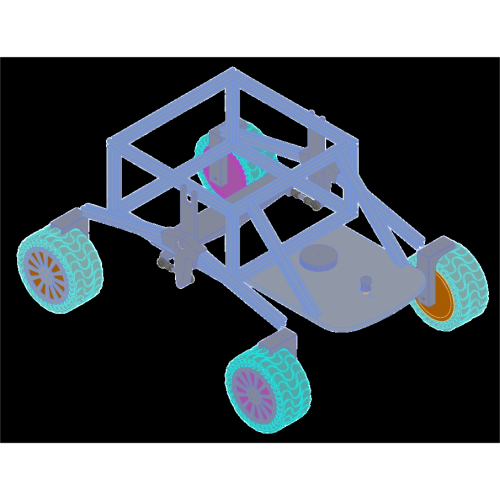
The rover features a lightweight, modular chassis built from composites and aluminum. It utilizes a Rocker-Bogie suspension system to ensure stability and adaptability when traversing irregular obstacles. The vehicle is equipped with custom TPU wheels optimized through Finite Element Analysis (FEA) to provide maximum traction and flexibility across diverse surfaces.
A mechanical arm with 6 degrees of freedom, constructed from aluminum and 3D-printed components, allows the rover to manipulate objects and collect samples weighing up to 10 kg. The system runs on software developed in C++ and Python, integrating LIDAR sensors for real-time 2D mapping and obstacle detection. The hardware includes advanced control systems, encoders, and dual-band communication (Radio and Wi-Fi), all powered by a high-performance 48V power system.
Software
Responsible for the circuits and energy systems that power the rover. They manage the power distribution, sensor integration, and communication modules to ensure reliability.
Teams
Structures
Responsible for the mechanical design, modular chassis, and Rocker-Bogie suspension. They develop custom TPU wheels and a 6-DOF robotic arm for sample collection and terrain mobility.
Hardware
Responsible for the rover’s autonomous intelligence using C++ and Python. They implement LIDAR mapping and pathfinding algorithms to enable independent navigation.
Drone
Responsible for the design and development of the aerial platform within BART. Includes mechanical design, communication systems, electronics, and autonomous control.



CONTACT US

© 2025, North Space – Associação de Estudantes para a Exploração Espacial – Todos os direitos reservados.
Climb Your Perspective
Rua de Mouzinho da Silveira 234 6/8,
4050-417, Porto, Portugal